
 FISHING AND COAST GUARD
Fishing Boat Antenna: Marine 4G/5G Antennas for Fishing and Coast Guard Vessels
A fishing boat antenna has to keep position tracking, catch reporting, video transmission and crew communication running far from shore. Fishing boats and coast guard vessels work long hours in harsh sea conditions, so the right antenna is chosen by evaluating durability, range and router configuration together.
Connectivity Needs in Fishing and Coast Guard Operations
On these vessels, connectivity is not a comfort but part of the operation. Antenna selection is based on four key needs.
Range far from shore
Fishing grounds and patrol areas are far from shore. Antenna height, gain and 4×4 MIMO determine how far the connection can be carried.
Rough seas and vibration
Waves, salt water, UV and engine vibration act constantly. A marine-grade housing and stainless steel mounting hardware are essential.
Mission-critical and redundancy
On coast guard vessels the connection must not drop. A dual modem with two operators provides link redundancy.
Data and video transmission
Position tracking, electronic catch logs and camera footage are sent to shore. For video transmission, uplink capacity is decisive.
Antenna by Router Port Count
A fishing boat antenna must match the number of cellular antenna ports on the router.

2 ports
Small boats in coastal fishing, compact router.
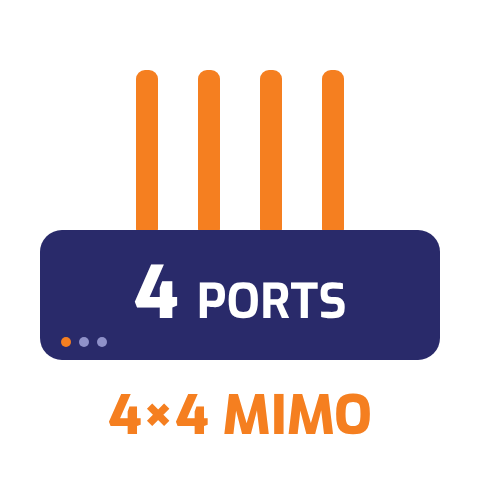
4 ports
Offshore fishing vessels, 4×4 MIMO 5G router.
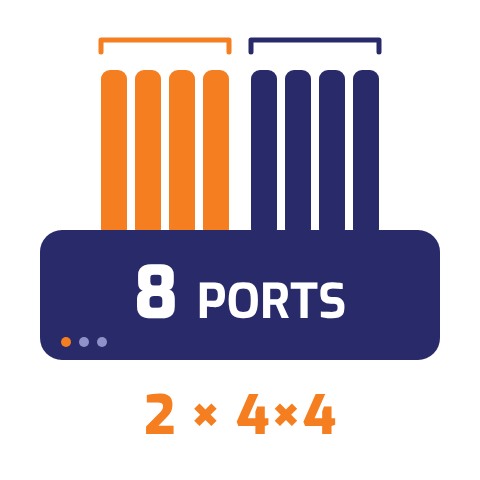
8 ports
Coast guard and patrol vessels, dual modem (2 × 4×4).
Where Will the Router Be: Wheelhouse or Inside the Antenna?
On fishing and coast guard vessels, the router's location determines the cable length and therefore the RF loss. Decide where the router goes before choosing the antenna model. More on this on the boat internet solutions page.
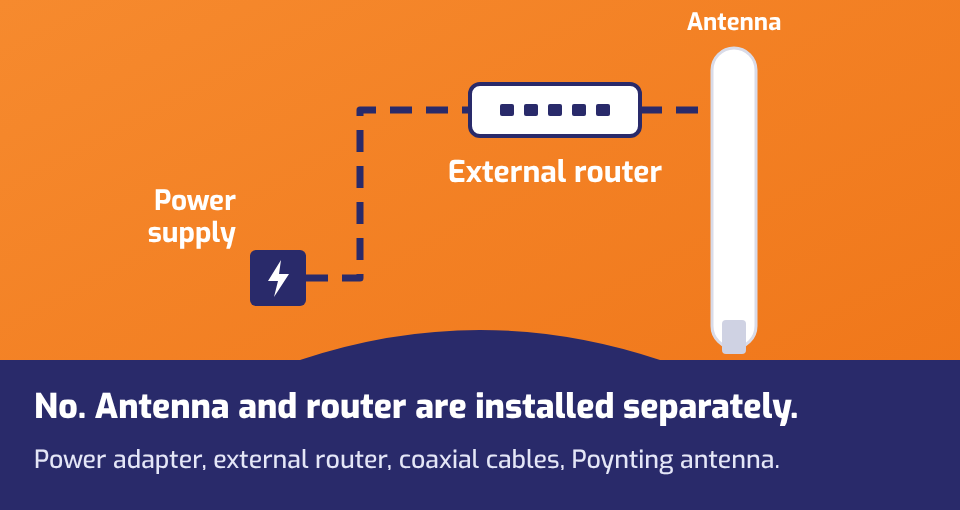
Router in the wheelhouse
The router stays indoors, protected from spray and vibration, and the antenna is connected by coaxial cables. SIM changes and maintenance are easy at sea. Keep the cable short and use low-loss cable, especially for 5G bands. Suitable antennas: OMNI-402, Narwhal OMNI-0902/0914, SWIRL-4/8.
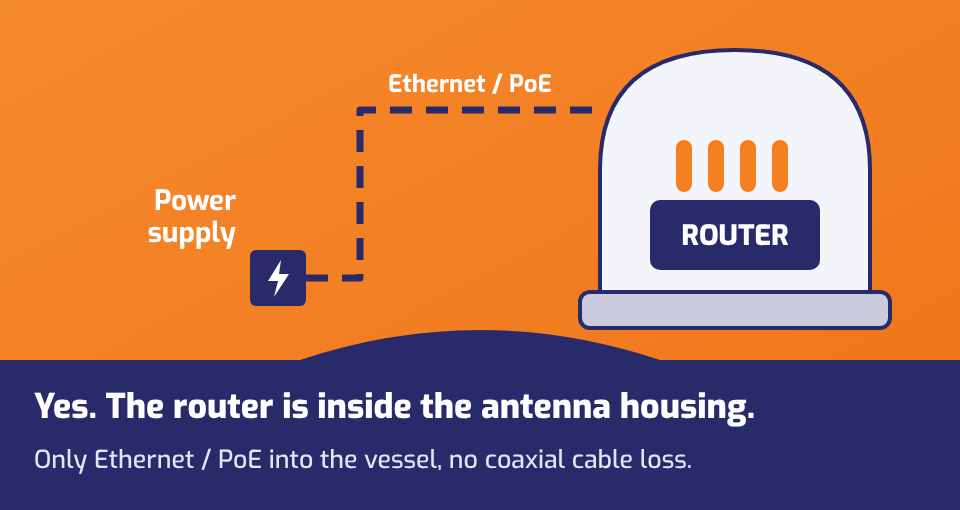
Router inside the antenna housing
On small, fast boats where space is tight or the cable route cannot be kept short, the router goes into the antenna housing; only an Ethernet / PoE cable runs into the boat and RF cable loss is practically eliminated. As SIM access is limited, eSIM or remote SIM management is recommended. Suitable antennas: SWIRL-4-CPE, SWIRL-8-CPE.
Recommended Antennas for Fishing and Coast Guard
Every fishing boat antenna below is designed for marine use. Values are taken from the manufacturer's datasheets.
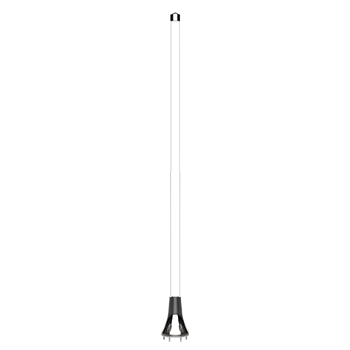
OMNI-0902 (Narwhal)
- Frequency617–4200 MHz
- Gain8 dBi (LTE)
- Cellular2 ports · 2×2
- PatternOmni
OMNI-0914 (Narwhal)
- Frequency617–4200 MHz
- Gain8 dBi (LTE)
- Cellular4 ports · 4×4
- PatternOmni

OMNI-402
- Frequency410–4200 MHz
- Gain5.8 dBi (LTE)
- Cellular2 ports · 2×2
- PatternOmni

SWIRL-4
- Frequency617–6000 MHz
- Gain6 dBi (peak)
- Cellular4 ports · 4×4
- Extra portsWi-Fi · GNSS

SWIRL-4-CPE · SWIRL-8-CPE
- Frequency617–6000 MHz
- Gain6 dBi (peak)
- Cellular4 or 8 ports
- RouterInside the antenna
SWIRL-8
- Frequency617–6000 MHz
- Gain6 dBi (peak)
- Cellular8 ports · 2 × 4×4
- Extra portsWi-Fi · GNSS
Which Fishing Boat Antenna for Which Vessel?
Small coastal fishing boats
Position tracking, catch logs and crew communication with a compact 2-port router. High-gain Narwhal for more distant fishing grounds.
OMNI-402 · OMNI-0902Offshore fishing vessels
A more stable connection far from shore with a 4×4 MIMO 5G router. A combination antenna if position and Wi-Fi are also needed.
OMNI-0914 · SWIRL-4Coast guard fast boats
For limited space and a short cable route, the router sits inside the antenna housing; only Ethernet / PoE runs into the boat.
SWIRL-4-CPECoast guard and patrol vessels
Dual modem and two operators for mission continuity; high uplink capacity for video transmission.
SWIRL-8 · SWIRL-8-CPEFishing Boat Antenna Comparison
| Model | Frequency | Gain | Cellular ports | Wi-Fi / GNSS | Router |
|---|---|---|---|---|---|
| OMNI-402 | 410–4200 MHz | 5.8 dBi | 2 (2×2) | – | External |
| OMNI-0902 | 617–4200 MHz | 8 dBi | 2 (2×2) | – | External |
| OMNI-0914 | 617–4200 MHz | 8 dBi | 4 (4×4) | – | External |
| SWIRL-4 | 617–6000 MHz | 6 dBi (peak) | 4 (4×4) | Yes | External |
| SWIRL-8 | 617–6000 MHz | 6 dBi (peak) | 8 (2 × 4×4) | Yes | External |
| SWIRL-4/8-CPE | 617–6000 MHz | 6 dBi (peak) | 4 or 8 | Yes | Inside the antenna |
Installation and Durability
- Mount the antenna at an open, high point such as the wheelhouse roof or radar mast, outside the radar beam and away from VHF antennas.
- On fast boats, use rugged stainless steel mounting hardware that withstands vibration.
- Keep the coaxial cable short and choose low-loss cable.
- Protect connectors against salt water with self-amalgamating sealing tape.
- A lightning arrestor on the antenna line is recommended.
- More details: marine antenna installation · lightning protection for boats · signal range at sea
Other Commercial Marine Applications
For all yacht and commercial vessel applications, see the marine antenna selection guide.




Frequently Asked Questions About Fishing Boat Antennas
Which antenna gives a fishing boat the longest connection range?
Why is a dual modem used on a coast guard boat?
What is needed to transmit camera footage to shore?
Does a fishing boat antenna replace AIS or VHF antennas?
Let's choose the right antenna and router setup for your vessel
Share your vessel type, operating area, router model and the data to be transmitted, and we will define the antenna system for your fishing or coast guard application.