

OMNI-0914 4×4 MIMO Marine 4G/5G Antenna
The Poynting OMNI-0914 marine antenna is the longest-range 4×4 MIMO model in the Narwhal series. Designed for superyachts, vessels and coastal sites, this omnidirectional antenna packs four 8 dBi elements covering 617–4200 MHz into an IP68 fibreglass radome.
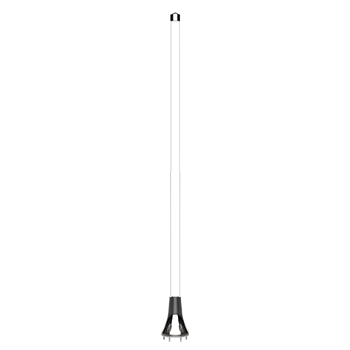
What Is the Poynting OMNI-0914?
The Poynting OMNI-0914 is a 4×4 MIMO marine antenna with four high-gain 8 dBi omnidirectional elements inside a long fibreglass radome. It is the tallest model in the Narwhal series and is built for maximum range offshore.
The 617–4200 MHz range covers the 700, 800, 900, 1800, 2100 and 2600 MHz bands used for 4G and 5G, as well as the 3.5 GHz (n78) 5G band. The 8 dBi gain of all four elements concentrates energy in the horizontal plane towards the horizon, so on 4×4-capable 5G routers all four data streams are received with high gain. The antenna is omnidirectional on every band and needs no pointing while the vessel turns or lies at anchor.
- 617–4200 MHz: 2G, 3G, 4G and 5G, including the 2.4 GHz Wi-Fi band
- 4×4 MIMO: four 8 dBi elements, 360° coverage
- IP68 fibreglass radome: marine grade, salt-mist and UV resistant
- N-type (female) connectors; version with 2 m HDF-195 cable or without cable
- Marine mount; optional BRKT-90 stainless steel bracket
Which Narwhal model? For 2×2 routers, OMNI-0902; for offshore range combined with stability in harbour, OMNI-0904 with two 3 dBi and two 8 dBi elements; for maximum range, the OMNI-0914 with four 8 dBi elements. To compare the models: Poynting Narwhal series
Why Does the OMNI-0914 Use Vertically Separated Elements?
At sea, part of the signal arrives directly and part arrives after reflecting off the sea surface. Where the two waves overlap, the signal fades at certain heights. Because the four elements of the OMNI-0914 sit at different heights inside the radome, they do not fade at the same time, and the router can always use the stronger signal.
Omnidirectional antennas radiate very little straight up or down, so stacked elements are naturally well isolated from each other. A single mounting point on the mast is therefore enough for 4×4 MIMO, instead of four separate antennas.
Poynting OMNI-0914 Applications
Used wherever the connection must hold as the vessel moves away from the coast, especially on larger vessels.
Superyachts
Uninterrupted internet for guests and crew.
Vessels
Communication on leisure and work boats.
Ferries
Passenger Wi-Fi and operational data.
Harbour and coast
Marinas and coastal facilities.
Mounting and Technical Drawing
The antenna is fixed to a mast or rail with a marine mount. For placement rules, see: marine antenna installation
Poynting OMNI-0914 Specifications
| Frequency | 617–4200 MHz |
|---|---|
| Gain | 4 elements, 8 dBi each (excluding cable loss) |
| MIMO | 4×4, four ports, vertically separated elements |
| Polarisation | Linear |
| Radiation | Omnidirectional, 360° |
| Connector | N-type (female) |
| Radome | Fibreglass, white |
| Protection | IP68, salt-mist and UV resistant |
| Temperature | −40 °C to +80 °C |
| Mounting | Marine mount; optional BRKT-90 (316 stainless steel) |
| Package | 2550 × 180 × 210 mm |
Order codes
| Order code | Cable | Package weight |
|---|---|---|
| A-OMNI-0914-V1-01 | HDF-195, 2 m | 9.42 kg |
| A-OMNI-0914-V1-02 | No cable | 9.40 kg |
On larger vessels the router is usually far from the antenna, so the cable-less V1-02 version combined with a low-loss cable cut to the route often gives better results.
Datasheet and Resources
Poynting OMNI-0914 FAQ
What is the difference between the OMNI-0914 and the OMNI-0904?
Both are 4×4 MIMO Narwhal antennas. The OMNI-0904 uses two 8 dBi and two 3 dBi elements, covering both near-shore and offshore use. The OMNI-0914 uses four 8 dBi elements and a taller body for maximum range offshore.
How does it perform in harbour or very close to shore?
The vertical beam of the 8 dBi elements is narrow, so the signal may weaken slightly when the vessel is right below a base station on a high hillside. For vessels that mostly stay in harbour or near the coast, the OMNI-0904 is the more balanced choice.
Is it a directional antenna?
No. The OMNI-0914 is omnidirectional and provides 360° coverage regardless of the vessel's heading. The high gain comes from concentrating radiation in the horizontal plane.
How is it connected to the router?
The antenna has N-type (female) connectors. Routers usually have SMA connectors, so low-loss cables with N-type (male) on one end and SMA (male) on the other are used. Each of the four ports is connected with its own cable.
What range can it reach at sea?
Range is mainly determined by antenna and base station height; beyond the radio horizon the signal drops quickly. For details, see our 4G/5G signal range at sea page.
Contact BağLAN about the Poynting OMNI-0914
BağLAN is the official distributor of Poynting in Türkiye. Tell us about your vessel, router model and cruising area, and we will help you choose the right antenna, bracket and cables: bilgi@baglan.com.tr · +90 212 358 59 09