
4G 5G Signal Range at
Sea and the Radio Horizon
4G/5G range at sea is not a fixed number of kilometres. Antenna heights, base station location, frequency and atmospheric conditions decide it together; offshore, the most important physical limit is the radio horizon.
What Determines 4G 5G Signal Range at Sea?
4G 5G signal range at sea does not depend on a single factor; the three elements below are assessed together.
- Antenna heightHow high the outdoor antenna is mounted above sea level extends the radio horizon.
- Base stationThe antenna height of the station on shore and its position in the terrain directly affect range.
- RF conditionsFrequency, antenna direction, power, antenna system, cable losses, RSRP/SINR and the atmosphere determine availability and stability.
What Is the Radio Horizon?
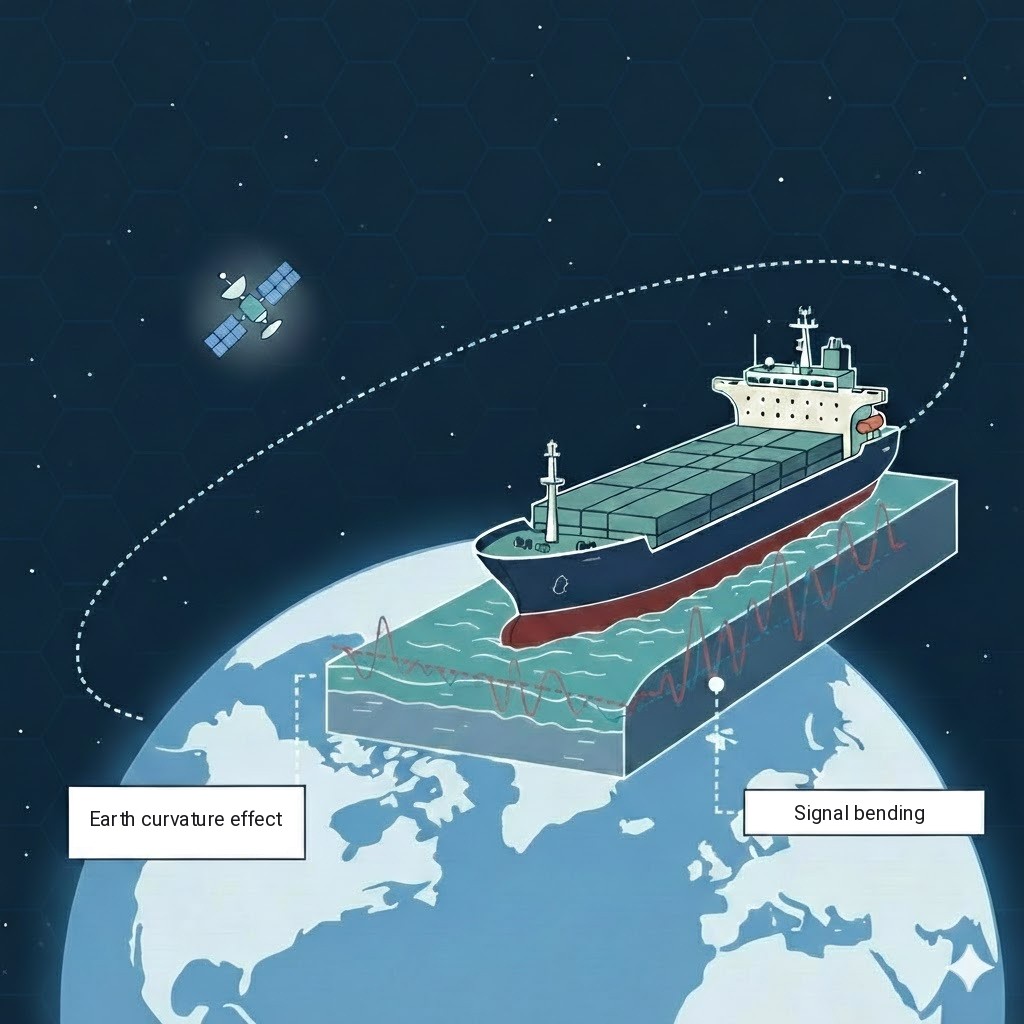
Because of the Earth's curvature, the line of sight between two antennas is limited. Radio waves bend slightly in the atmosphere, so this limit lies a little beyond the visible horizon; this is called the radio horizon.
The radio horizon is proportional to the sum of the square roots of the two antenna heights (boat and base station). So when one antenna's height doubles, the distance does not double; the increase is not linear.
How Is the Radio Horizon Calculated?
d: approximate radio horizon distance · h1: antenna height on the vessel · h2: base station antenna height. Heights are measured from sea level. The formula assumes standard atmospheric refraction of radio waves (effective Earth radius factor k = 4/3).
Radio Horizon Calculator
Worked example
- Boat antenna 12 m√12 ≈ 3.464
- Base station antenna 25 m√25 = 5
- Sum8.464
- d ≈ 4.12 × 8.464≈ 34.9 km
This value is not a coverage guarantee; the actual connection range may be shorter.
Radio Horizon by Antenna Height
| Boat antenna | Base station antenna height | |||
|---|---|---|---|---|
| 25 m | 50 m | 100 m | 200 m | |
| 3 m | 28 km15 nmi | 36 km20 nmi | 48 km26 nmi | 65 km35 nmi |
| 6 m | 31 km17 nmi | 39 km21 nmi | 51 km28 nmi | 68 km37 nmi |
| 12 m | 35 km19 nmi | 43 km23 nmi | 55 km30 nmi | 73 km39 nmi |
| 20 m | 39 km21 nmi | 48 km26 nmi | 60 km32 nmi | 77 km41 nmi |
Is 30 km the Limit of Mobile Coverage?
No. Values such as 30 km are not a hard physical limit; they can only be used as a practical reference.
With a high boat antenna and a base station positioned high on the coast, the radio horizon can exceed 30 km. Conversely, a low antenna, weak signal, high cable loss or poor RF conditions can end the connection at a much shorter distance.
Important: The radio horizon does not mean a connection will definitely be established at that distance. It only shows the furthest point at which line of sight is geometrically possible.
Sea Surface, Multipath and Fading
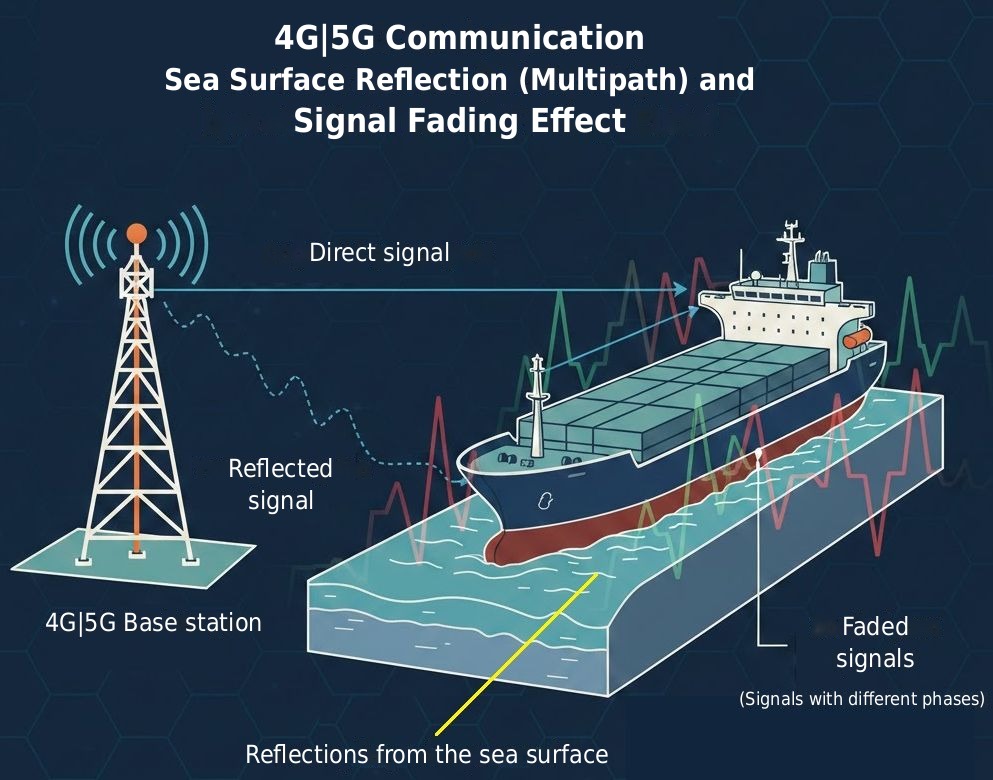
The sea surface is a strong reflector. The direct signal and the reflected signal reach the antenna with different phases and create constructive or destructive interference; this is called multipath.
Even when the distance changes very little, clear fluctuations can be seen in RSRP and especially in SINR.
- Reflected signals can reach the antenna with different phases.
- The boat's motion constantly changes the antenna geometry.
- Strong RSRP combined with low SINR can still give poor data performance.
- A connection should not be judged by antenna gain or distance alone.
Atmospheric Ducting and Unusually Long Ranges
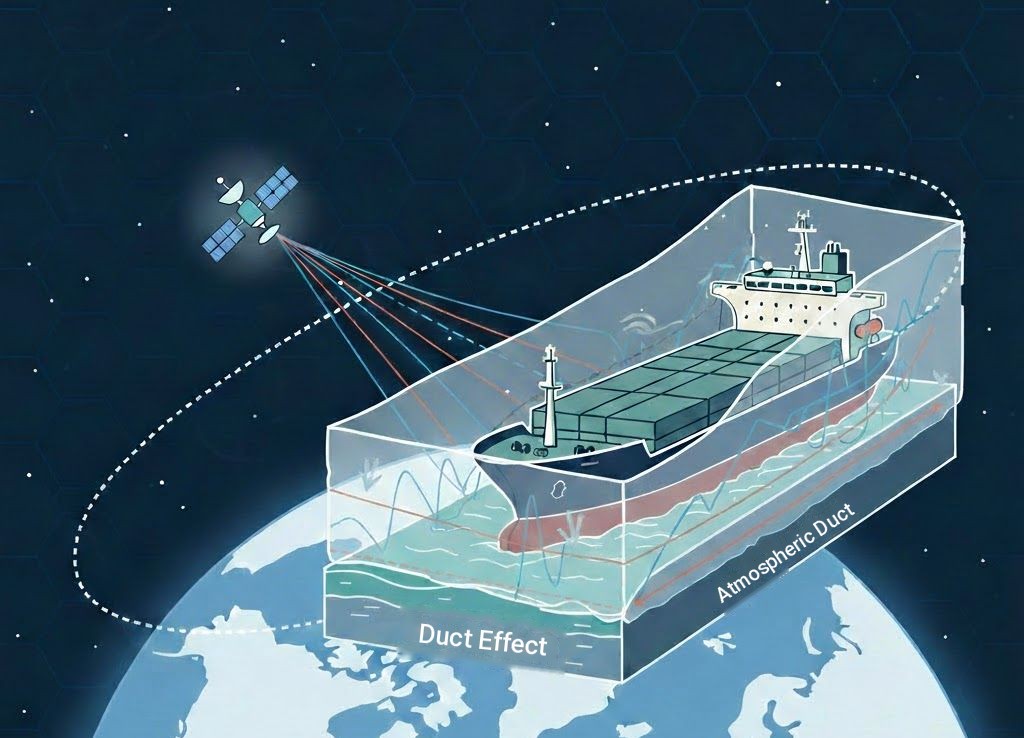
Changes in temperature and humidity with height can make radio waves refract differently from normal. This phenomenon is called atmospheric ducting.
When ducting occurs, signals can arrive from stations 50 km, 100 km or further away. However, this depends on weather conditions and is temporary.
Design rule: Unusually distant signals must be kept separate from sustainable normal coverage. Ducting is not used as a criterion in system design.
For a More Stable 4G/5G Connection at Sea
- Mount the outdoor antenna at a suitable, high point.
- Do not make the RF cable between the antenna and the modem or repeater longer than necessary.
- Account for cable and connector losses, especially at higher frequencies.
- The antenna and RF system must support the frequency bands used by the operator.
- Assess the connection with RSRP, RSRQ and SINR values, not just signal bars.
- Choose antennas and mounting hardware suited to the marine environment.
More About Marine 4G/5G Systems
This page explains the physical side of the radio horizon. In system design, the antenna, modem/router or repeater architecture must also be assessed.
For manufacturer product information, see Poynting marine and coastal antennas.
4G 5G Signal Range at Sea: Frequently Asked Questions
Are the radio horizon and coverage range the same thing?
No. The radio horizon is the furthest distance at which line of sight is geometrically possible. Coverage depends on having sufficient signal level and quality at that distance. 4G 5G signal range at sea is often shorter than the radio horizon.
Why can speed be low when RSRP looks good?
RSRP only shows the received signal level. Reflections from the sea surface and signals from other distant cells increase interference; when SINR drops, data speed falls even if the signal is strong. RSRP, RSRQ and SINR should therefore be assessed together.
How much does raising the antenna increase range?
The increase follows the square root. With the base station antenna at 25 m, raising the boat antenna from 3 m to 12 m extends the radio horizon from about 28 km to 35 km. A higher antenna also means a longer cable, so cable loss must be calculated as well.
Does 5G drop out at a shorter distance at sea than 4G?
The radio horizon is independent of frequency; the geometric limit is the same for 4G and 5G. The difference comes from the frequency band's effect on the link budget: high bands (e.g. 3.5 GHz) have more path loss and cable loss, so the signal can fall to an unusable level before reaching the radio horizon. Low bands, whether 4G or 5G, provide usable signal closer to the radio horizon.
Let's choose the right antenna and RF system for your boat together.
BağLAN Bilgisayar ve İletişim Sistemleri Ltd. Şti.