

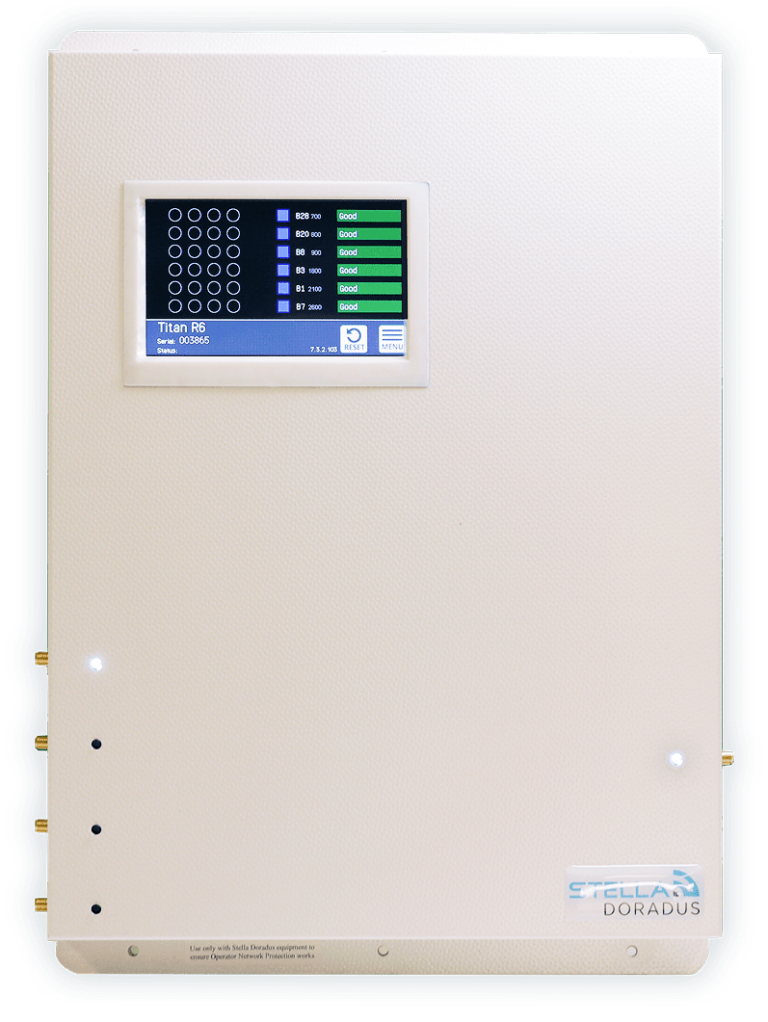

Stella Doradus Marine: Marine Cellular Repeater for Mobile Coverage on Board
Stella Doradus Marine is a professional multi-band marine cellular repeater developed to carry the cellular signal available from the mobile operator network on shore into the cabins and other enclosed living spaces of boats, yachts and other vessels. The system can be built on the iRepeater architecture, which supports the 700, 800, 900, 1800, 2100 and 2600 MHz cellular frequency bands.
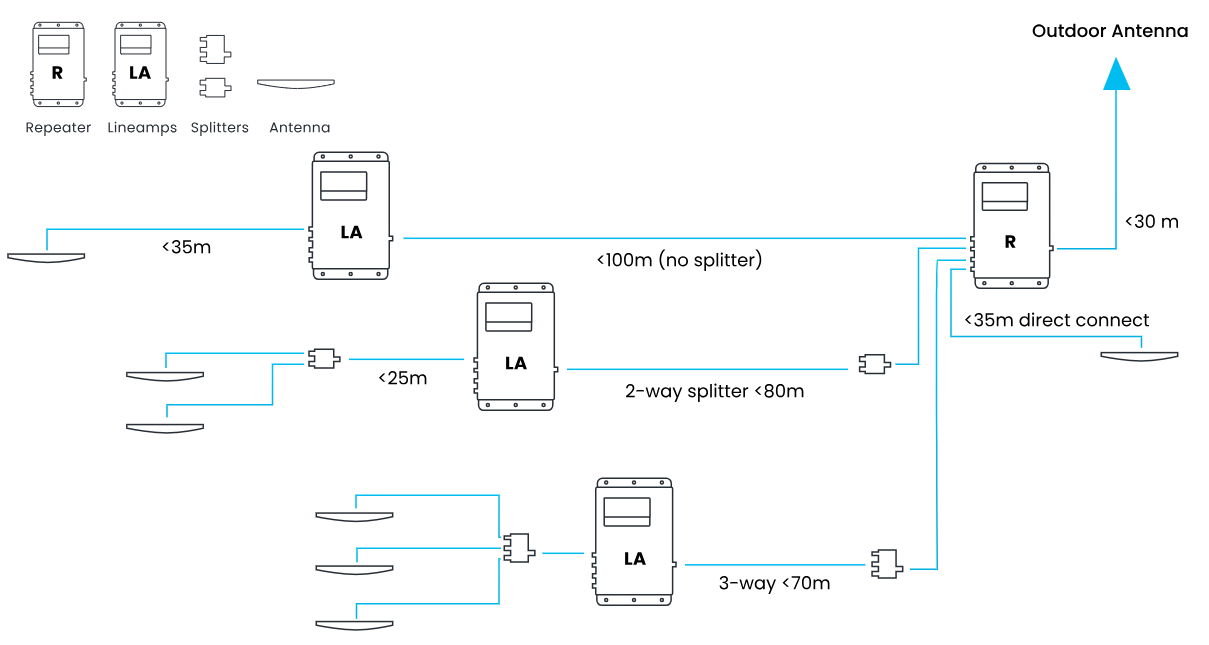
On large yachts and multi-compartment vessels, when the RF signal has to be carried to more distant points, the iRepeater can be used together with Stella Doradus LineAmp line amplifiers. The mobile signal can then be distributed to cabins, saloons, technical spaces and other target areas through a suitable RF distribution design and indoor antennas.
Stella Doradus iRepeater and LineAmp devices can be tracked through the remote monitoring and management platform. Authorised users can check the operating status of the system from a computer, phone or tablet; this makes operation and maintenance easier, especially in professional marine applications that require remote technical follow-up. For all connectivity components on board, see our boat internet solutions page.

No SIM Required
The mobile signal is carried simultaneously on the operating frequencies of all operators.

Made in Europe
Designed and manufactured in Ireland by expert engineers.

Fully Compliant
European R.E.D and E.T.S.I approved, meets ComReg specifications.

All Network Support
Supports all GSM, 3G, 4G and 5G mobile operator networks and frequencies.

Optional Extended Warranty
The warranty period can be extended to 7 years with an additional support package.

Reliable Distribution Support
Backed by BağLAN's ongoing technical support and after-sales service.
5G and Mobile Frequency Bands
5G Frequencies
5G is delivered on different frequency bands depending on each operator's spectrum plan. Low bands provide wider coverage; existing bands such as 2100 MHz can also be used for 4G and 5G. Depending on the model, multi-band Stella Doradus systems support many bands from 700 MHz to 2600 MHz.
Carrier Aggregation
Carrier Aggregation combines multiple carriers on compatible networks to deliver higher bandwidth. A multi-band repeater repeats the supported bands simultaneously, helping these carriers to be used inside the vessel as well.
New Mobile Spectrum
Operator frequencies vary by country, licensing and network planning. In some markets, additional spectrum such as 1500 MHz and 2300 MHz is used for capacity. The bands to be supported should therefore be chosen according to the operators in the cruising area and the application's needs.
How Does the Stella Doradus Marine Cellular Repeater Work?
A 360° omnidirectional marine antenna mounted at a suitable outdoor point on the vessel receives the cellular signals reaching it from the mobile operator base stations on shore. While the boat or yacht is under way, the signal received from different base stations is carried over RF cable to the Stella Doradus iRepeater.
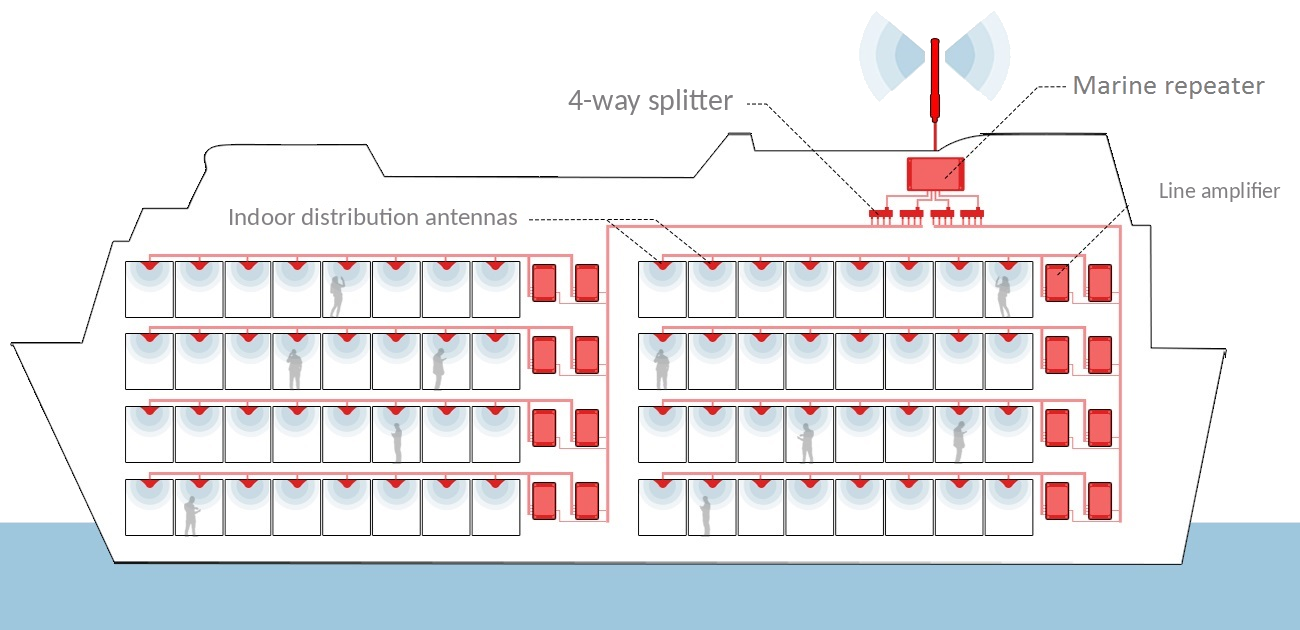
The iRepeater processes the signals in the supported cellular frequency bands in a controlled way and passes them to the RF distribution system. On large yachts or in applications with many enclosed spaces, LineAmp line amplifiers can be used to carry the RF signal to more distant points and distribute it through multiple indoor antennas to cabins, saloons and other target areas.
During operation, the system monitors RF levels to help the mobile network be repeated within safe limits. The operating status of iRepeater and LineAmp devices can be monitored remotely, so control and technical follow-up of the system can be carried out centrally in professional marine installations.
Range to the Mobile Network from Shore

For Stella Doradus Marine systems, a distance of approximately 30 km can be used as an application reference for access to the mobile network on shore. However, the actual range of a cellular connection at sea is not fixed. The height of the vessel's outdoor antenna above sea level, the height of the base station on shore, the mobile frequency used, the base station's location and orientation, the available RF signal level and atmospheric conditions all directly affect the achievable distance.
A 360° omnidirectional marine antenna mounted at a suitable and as high as possible outdoor point on the vessel helps receive signals from mobile operator base stations in different directions while under way. As antenna height increases, the radio horizon extends, so under suitable conditions usable mobile signal may also be received from base stations beyond 30 km.
What Determines Mobile Connection Range at Sea?
For mobile connectivity at sea, the radio horizon matters, not just the distance in kilometres. As the antenna heights on the boat or ship and at the base station on shore increase, the theoretical distance at which they can see each other within radio line of sight also increases.
30 km is therefore not a hard maximum coverage limit. With suitable antenna height and RF conditions, more distant base stations can be reached; conversely, with low antenna height, a weak base station signal or unfavourable propagation conditions, the range may be shorter.
For more detail on how antenna height, radio horizon, sea surface reflections and atmospheric propagation affect mobile connection range, see our 4G/5G Signal Distance at Sea and Radio Horizon page.
The usable mobile signal received by the outdoor antenna is processed by the Stella Doradus iRepeater, the core of the marine cellular repeater system. On large yachts and multi-compartment vessels, LineAmp line amplifiers can be used where needed to carry the RF signal to more distant points and distribute it through indoor antennas to cabins, saloons and other enclosed spaces.
- Scalable system architecture for large boats, megayachts, passenger ships, tankers and ferries
- Cellular technology support: GSM / 3G / 4G / 5G
- Model options matched to European mobile network frequencies
- Serves multiple users simultaneously without a SIM card
- Scalable RF distribution on large and multi-compartment vessels using iRepeater and LineAmp
- Status indicators for monitoring system operation
- Balanced mobile coverage on board with indoor antennas placed according to the RF design
- Automatic RF control features to protect the mobile operator network
Manufacturer: Stella Doradus (Ireland) · BağLAN is the Turkey representative of Stella Doradus products.
Stella Doradus Marine on Large Ships
On large ships, the 4 RF outputs of the Stella Doradus iRepeater marine cellular repeater can be connected to LineAmp line amplifiers where needed. LineAmp devices also have 4 RF outputs. The system can therefore be scaled to suit the RF design, taking into account the ship's size, deck structure, compartments and the indoor coverage area required.
This system has been tested with 200 antennas serving a total of 600 standard cabins. The iRepeater and LineAmp architecture distributes RF power within the system in a controlled and balanced way, helping to create mobile coverage in cabins, saloons, corridors and other enclosed spaces.
Stella Doradus Marine Remote Monitoring and Management
Alarms and Email Alerts
- Alarm and operating status information within the system can be monitored remotely, and email alerts can be generated depending on the configuration.
- If a device's power connection is lost or a power problem occurs in the system, the device concerned and its location can be checked remotely.
- System parameters such as oscillation, high RF power, band status and device temperature can be monitored.
Remote Control by Phone or Computer
- The operating status and RF parameters of the supported frequency bands can be managed remotely.
- The operating status of devices in the system can be checked centrally.
- Supported devices can be restarted remotely when needed.
Monitoring
- Downlink / Uplink RF power levels
- Downlink / Uplink gain values
- Downlink / Uplink AGC values
- Oscillation / feedback status
- PCB / device temperature
History and System Logs
- System operating information and related device events can be reviewed retrospectively through the monitoring platform.
- Operating and usage information for the supported frequency bands can be followed during system management.
Remote Monitoring Platform
With the Stella Doradus remote monitoring platform, the operating status, RF parameters and alarm information of supported devices in the system can be tracked centrally. This makes managing a marine cellular repeater system easier, especially on large yachts, passenger ships and in marine applications with many RF distribution points.
Stella Doradus Marine Network Protection Features

Oscillation and Feedback Detection
When there is not enough RF isolation between the outdoor and indoor antennas, feedback and oscillation can occur. This is similar to the feedback heard when a microphone is brought close to a loudspeaker. The Stella Doradus system detects this condition and automatically reduces gain, helping to prevent oscillation from harming the mobile network and system performance.

Automatic Gain Control
The system continuously monitors RF signal levels and automatically sets the required gain. When the signal level received from the base station changes, the repeater gain is kept at a suitable level. This control mechanism helps prevent excessive RF output and unwanted RF effects on the mobile network.

Smart Standby and Noise Control
When there is no mobile traffic, the system does not keep its RF output unnecessarily high. When a call or data session starts, the required RF transmission is provided. This operating principle helps reduce unnecessary RF emission and uplink noise, allowing the mobile network to be used in a more controlled way.

Power Control Based on Base Station Signal Level
The Stella Doradus system automatically adjusts its operating parameters according to the RF signal level received from the base station.
a) When the base station is far away and the received signal is weak, the system increases the required gain.
b) When approaching the base station and the received signal level rises, gain is reduced automatically.