

Lightning Protection for Boats
and Grounding
Correct grounding, equipotential bonding and antenna line protection for the mast, antennas and cabin electronics. A practical guide for sailboats, metal-hulled yachts and commercial ships.

Lightning risk at sea
At sea, a boat is often the highest point around. Lightning protection for boats means carrying the lightning current to the sea along the lowest-resistance path, preventing dangerous voltage differences on board and limiting the surge entering through antenna lines at the cabin entry.
Grounding
A continuous, low-resistance down conductor from the masthead to the underwater ground plate.
Equipotential bonding
All metal parts on board are joined at a common bonding bus, preventing side flashes and touch voltage.
Surge protection
Protectors fitted to antenna cables and power lines limit the surge voltage reaching the electronics.
Hull construction sets the approach
The right approach to lightning protection for boats depends on the hull material, because it sets the path of the lightning current. A metal hull forms a natural conductive cage, while on wooden and composite boats this path has to be built separately. Antennas must be protected separately in every case.
Sailboat, wood or composite
Tall mast, non-conductive hull- Risk
- The mast is the direct strike point; the current may seek an uncontrolled path through the hull.
- Measure
- A down conductor from the mast to an underwater copper ground plate, with all metal parts bonded.
- Antennas
- A lightning arrester on every antenna cable at the cabin entry.
Metal-hulled yacht
Steel or aluminium hull- Risk
- The hull carries the current to the sea, but voltage entering through cables can still reach the electronics.
- Measure
- A solid mast-to-hull connection and equipotential bonding of the interior equipment.
- Antennas
- Protection on every antenna line on the mast and radar arch.
Commercial ship
Steel hull, rule-based earthing system- Risk
- Many antennas, radars and communication systems; a failure affects navigational safety.
- Measure
- An earthing system compliant with class rules and a single bonding network.
- Antennas
- Additional lightning arresters on cellular, Wi-Fi and satellite lines.
How should lightning current travel through a boat?
- 1Masthead and antennas: The highest point of the boat, where the first contact occurs.
- 2Down conductor: A continuous copper line from the mast to the ground plate, at least 21 mm² (4 AWG).
- 3Ground plate: Below the waterline; the current dissipates into the sea from here.
- 4Lightning arrester: Where the antenna cable enters the cabin, one on every coaxial line.
- 5Modem / router: The equipment protected behind the arrester.
- 6Bonding bus: The arrester's ground terminal and all metal parts are tied to a common potential.
Grounding on sailboats
- The mast and antennas are natural targets. Because they are high, they become the first contact point for lightning.
- Copper down conductor. A copper conductor of at least 21 mm² cross-section from the masthead (including antennas) to the underwater ground plate is recommended. The run should be as straight and short as possible, without sharp bends.
- A metal mast alone is not enough. An aluminium mast is a good air terminal, but on a wooden or composite hull the mast step must be connected to the ground plate with a down conductor.
- The metal hull advantage. A steel or aluminium hull acts like a Faraday cage and carries the current to the sea; a solid mast-to-hull connection is sufficient.
- Wooden and composite hulls. A copper ground plate is mounted below the waterline, and the conductor from the mast is connected to it.
Using the rolling sphere method, yachts are classified at protection level LPS III (sphere radius 45 m). The mast is the point lightning reaches easily and from which lightning current can enter the deck and, through cables, the inside of the boat. Most of the lightning current is carried from the mast to the hull and the water; partial currents spread through cables and metal fittings.


Equipotential bonding and surge protection
Equipotential bonding
- Metal structures on board are connected to the lightning protection system to create a common potential.
- The protective conductors of the panel electronics and all metal parts of the boat are connected to a common bonding bus, preventing dangerous touch voltage and sparks.
- When all systems are tied together, no random arc points remain; the current stays on the designed path.
- Conductors and connections are chosen from corrosion-protected materials resistant to salt water, humidity and vibration.
Surge (overvoltage) protection
- Even with an external down path, dangerous voltages can appear at other points on the boat, causing arcs and side flashes.
- Damage to navigation and communication equipment directly affects the safety of the boat and crew.
- Surge protective devices are used on power lines, RF lightning arresters on antenna lines.
- The protector's ground terminal must be connected to the bonding bus with a short, heavy conductor; a long ground lead weakens protection.
Protecting modem and antenna systems
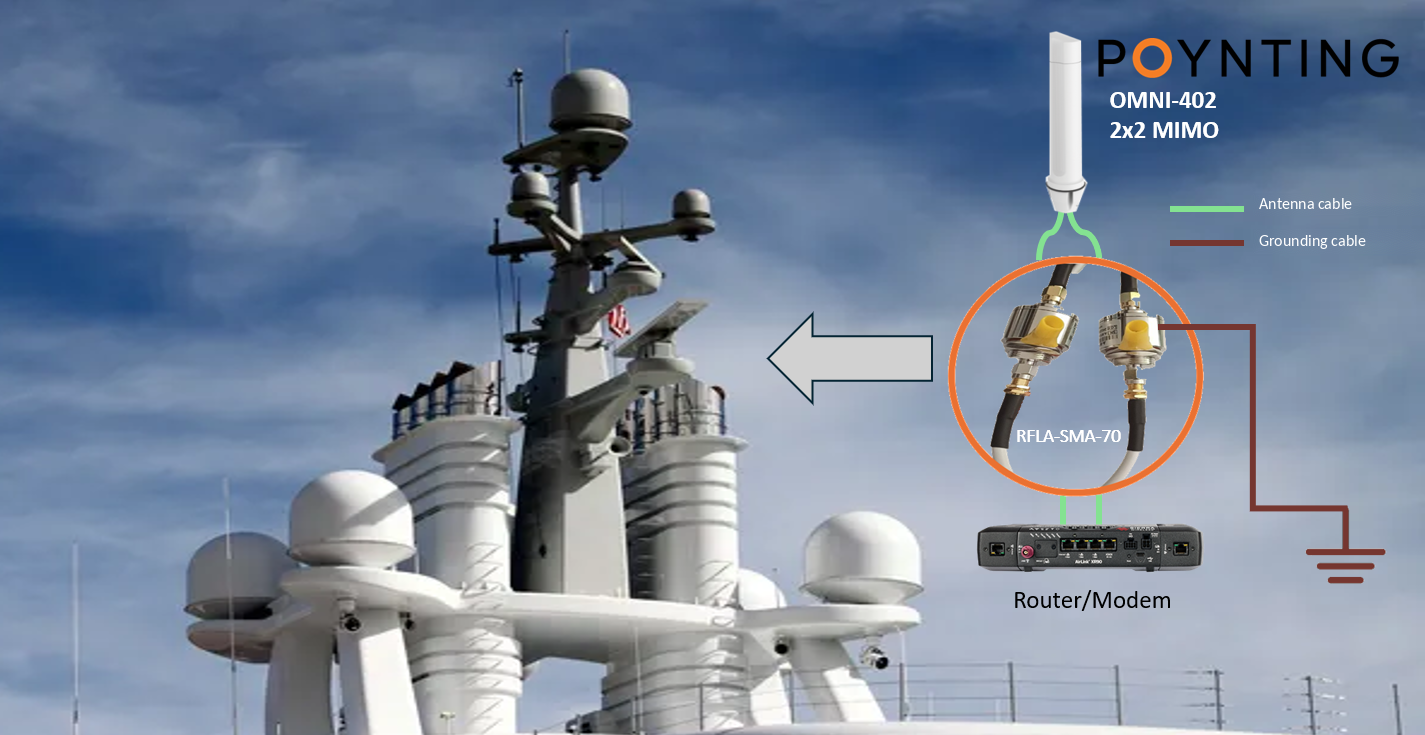
In lightning protection for boats, the copper conductor running from the mast to the sea is the most critical protection path on sailboats. On metal-hulled yachts and ships the hull provides natural grounding, but additional protection for antennas is always needed. The antenna mast or bracket should be connected to the grounding line on the mast.
An RF lightning arrester fitted between the modem and the antenna diverts lightning-induced voltage surges to ground and greatly reduces the risk of damage to the modem and connected devices.
Correct practice: One arrester is fitted on every coaxial antenna cable. A 2×2 MIMO antenna needs two arresters, a 4×4 MIMO antenna four. The arrester is mounted where the cable enters the cabin, as close as possible to the bonding bus.

A-RFLA-SMSF-070 RF lightning arrester
As an antenna manufacturer, Poynting also offers an RF lightning arrester compatible with its own antennas. The A-RFLA-SMSF-070 diverts overvoltage away from sensitive equipment and discharges it to ground. It is bidirectional, protecting against surges from the antenna to the equipment and from the equipment to the antenna. Low insertion loss preserves signal quality, and its brass body withstands the marine environment. On antenna lines it is a key part of lightning protection for boats. For application examples, see Poynting's RF lightning arrester article.
Grounding on commercial ships and large vessels
- Standard systems: Large ships have earthing systems designed against both lightning and internal electrical faults.
- Steel hull: The hull provides natural grounding. For antennas, radars and communication systems, additional bonding conductors and RF lightning arresters such as the Poynting A-RFLA-SMSF-070 are used.
- Single bonding network: All metal parts, including antenna masts, radar towers and cabin-top equipment, are tied together into a single grounding network.
Pre-season lightning protection check
- Is the down conductor continuous from the masthead to the ground plate?
- Is the ground plate clean, unpainted and below the waterline?
- Is there a lightning arrester on every antenna cable?
- Are the arresters' ground terminals connected to the bonding bus with a short lead?
- Is there corrosion on connections, and are outdoor connectors sealed?
- Is a spare modem or antenna ready in a closed space?
About lightning protection for boats
If the mast is metal, is separate grounding needed?
On metal-hulled boats, a solid mast-to-hull connection is usually sufficient. On wooden or composite boats a metal mast is a good air terminal, but a down conductor from the mast step to the underwater ground plate is needed for the current to reach the sea.
Does a lightning arrester protect the boat against a direct strike?
No. A lightning arrester protects the equipment behind it by limiting the overvoltage arriving on the antenna cable. Protection against a direct strike comes from the external protection system made up of the mast, down conductor and ground plate.
How many lightning arresters does a MIMO antenna need?
One for each coaxial cable. A 2×2 MIMO antenna uses two arresters, a 4×4 MIMO antenna four. Wi-Fi and GNSS cables must be protected too.
Can a lightning arrester be used with GNSS antennas?
Yes. The A-RFLA-SMSF-070 works from DC to 7 GHz and passes DC, so the supply voltage for active GNSS antennas continues to pass along the line.
What should be done during a thunderstorm?
If possible, stay in the cabin, away from metal parts and the mast step. Non-critical electronics can be switched off; keep the spare modem and portable devices in a closed space.