

Poynting Lightning ArrestorA-RFLA-SMSF-070 · DC–7 GHz coaxial protection
The Poynting lightning arrestor diverts lightning-induced surges from the antenna to ground, protecting sensitive equipment such as routers, modems and GNSS receivers. It works bidirectionally on cellular, Wi-Fi, satellite and GNSS lines.

What does the Poynting lightning arrestor do?
Even without a direct strike, a nearby lightning flash induces a high-voltage surge in the antenna and cable. The A-RFLA-SMSF-070 diverts this surge on the coaxial line to ground through a gas discharge tube (GDT) and prevents it from reaching the equipment input.
Bidirectional protection
Works against surges travelling from the antenna to the equipment and from the equipment to the antenna.
DC–7 GHz
The same arrestor can be used on cellular, Wi-Fi, satellite and GNSS lines.
Low loss
Insertion loss below 1 dB across 90% of the bands; VSWR below 1.4:1.
Rugged housing
Tri-alloy plated brass housing, IP67 and an operating range of −45…+80 °C.
Without and with lightning protection
If a surge reaches the router or modem through the antenna cable, it burns out the equipment input. The arrestor diverts this surge to ground before it reaches the equipment.
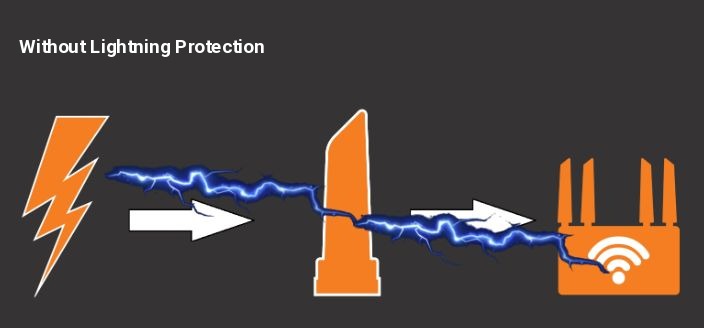
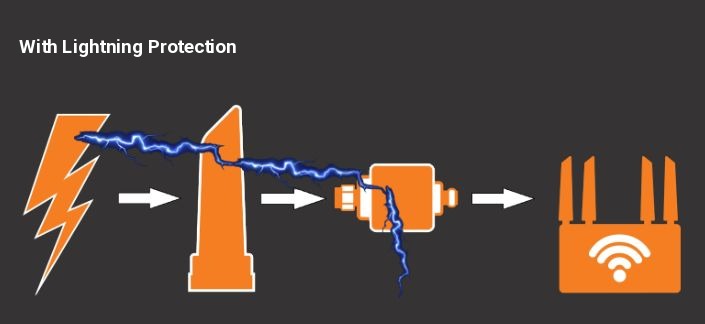
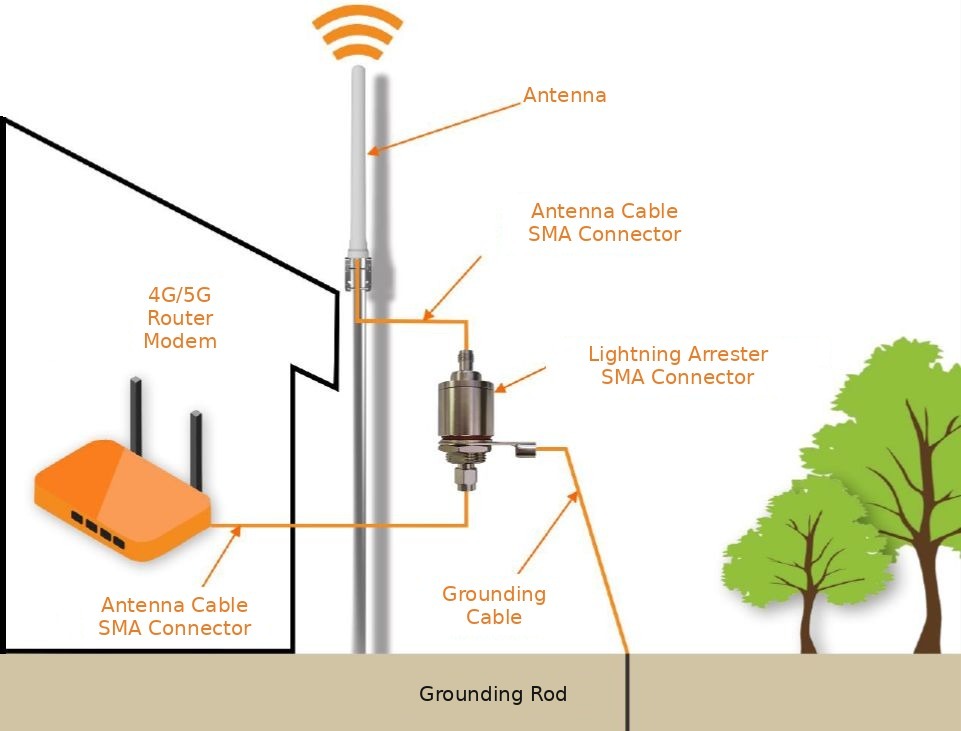
Lightning arrestor installation in the field
On an antenna with two coaxial lines, a separate arrestor is fitted to each cable.


Poynting lightning arrestor specifications
| Frequency range | DC – 7 GHz |
| Impedance | 50 Ω |
| VSWR | Below 1.4:1 (across 90% of the bands) |
| Insertion loss | Below 1 dB (across 90% of the bands) |
| Max. surge discharge current | 10 kA |
| Protection element | Gas discharge tube (GDT) |
| Operating voltage | ≤ 1000 V RMS, 50 Hz |
| Rated DC voltage | 230 V |
| Dielectric strength | ≥ 2500 V RMS, 50 Hz |
| Connectors | Input SMA female · Output SMA male |
| Housing | Brass, tri-alloy (Cu-Zn-Sn) plating |
| Ingress protection | IP67 |
| Operating temperature | −45 °C … +80 °C |
| Size / weight | 55 × 25 × 39 mm · 85 g |
| Standards | UL 1449:2006 · IEC 61000-4-5:2014+AMD1:2017 · CE · RoHS |
Product code
The connector types are fixed. Cables and devices with different connectors require a suitable adapter.
Download datasheetLightning protection on boats
The highest point on a boat is usually the mast, and lightning tends to strike there. The coaxial cables of mast-mounted VHF, Wi-Fi, 4G/5G and GNSS antennas can carry a surge straight into the cabin.
The Poynting lightning arrestor limits the surge where these cables enter the cabin and protects the equipment. Protection against a direct strike requires a down conductor connecting the mast to the boat's grounding; the arrestor does not replace it. The zone of protection is determined with the rolling sphere method: points the sphere touches can take a direct strike, points it does not touch are protected.
For detailed information on boat installations, see the lightning protection for boats page.

What to watch for when installing a lightning arrestor
Close to the entry point
Fit the arrestor where the coaxial cable enters the building or cabin, before the equipment.
Short, thick ground
Connect the housing to the common grounding bar by the shortest route. A long ground lead reduces the level of protection.
One arrestor per line
Multi-port MIMO antennas need a separate arrestor on each coaxial cable.
Sealing outdoors
The housing is IP67. Outdoors, also seal the connector joints with waterproof tape.
Where is it used?
Telecom infrastructure
Equipment input protection on base station, FWA and cellular antenna lines.
Broadcast and media
Surge protection of RF lines in broadcast and communication installations.
Wi-Fi and wireless networks
Outdoor Wi-Fi antennas and point-to-point links.
Satellite and GNSS
GNSS antennas and satellite receiver lines; since it passes DC power, it can also be used with GNSS.
Marine vessels
On the cables of mast-mounted antennas on boats and yachts. For details, see the lightning protection for boats page.
About the Poynting lightning arrestor
Does a lightning arrestor protect against a direct lightning strike?
No. The arrestor limits surges induced on the line by nearby flashes. Masts at risk of a direct strike also need a lightning rod and grounding.
What does 10 kA mean?
It is the maximum surge discharge current the arrestor can safely divert to ground. It is much lower than a direct lightning current, which is why it is rated for surges induced on the line.
Which lines can it be used on?
On 50 Ω coaxial lines in the DC–7 GHz range: cellular, Wi-Fi, satellite and GNSS. It has an SMA female input and an SMA male output.
How many arrestors do MIMO antennas need?
One arrestor per coaxial cable. For example, a four-port antenna uses four arrestors.
Does it work without grounding?
No. The arrestor discharges the surge to ground; without grounding it cannot provide protection.
The right protection for your installation
BağLAN is the official Poynting distributor for Turkey. Contact us for advice on lightning arrestors, grounding and installation for your antennas. For manufacturer information, you can also visit the Poynting website.