

Antenna Lightning Protection
Protect your connections from lightning-related failures: protection zones, the 45-degree protection cone and correct grounding.
 RFLA-SMSF-070 RF
Two questions stand out in antenna lightning protection: how is the antenna protected from lightning, and how is lightning energy prevented from passing through the antenna to the connected equipment?
The information on this page is general guidance compiled from lightning protection courses; it is not specific to Poynting antennas mounted on tall structures and applies to every antenna installation.
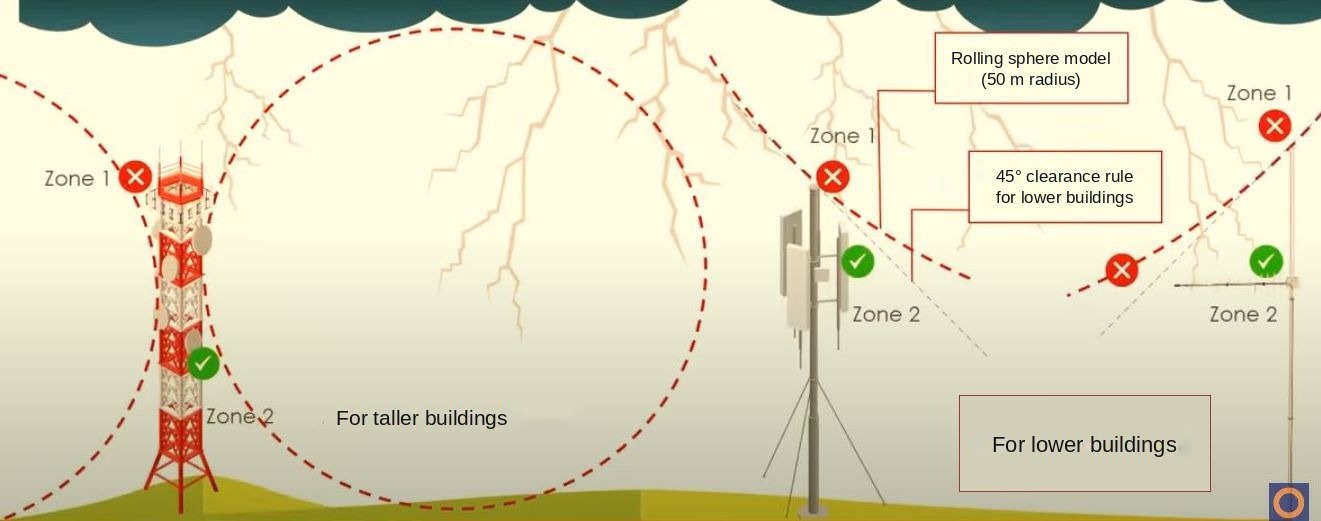
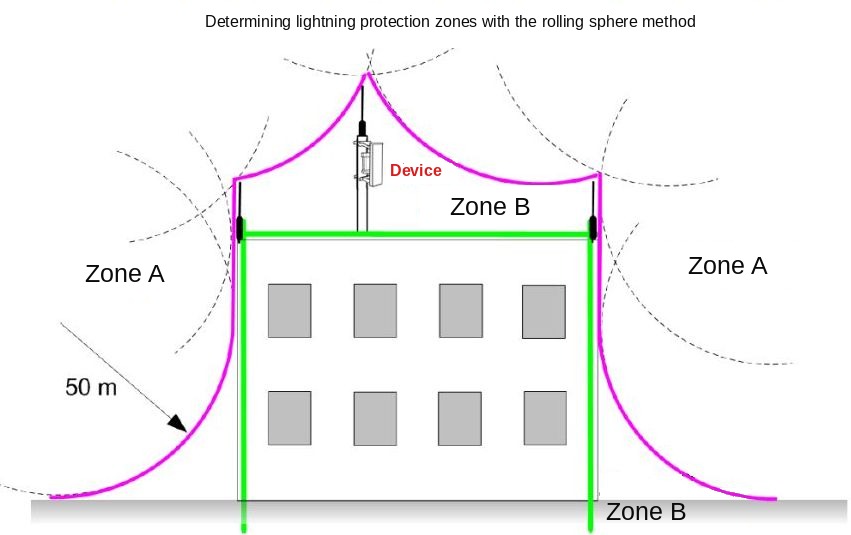
Antenna lightning protection zones
When mounting an antenna on a tall building or mast, the protection zone of the mounting location is determined with the rolling sphere method. The method distinguishes two cases: zone A and zone B.
Case 1: Zone A
The antenna is highly likely to be exposed to a direct lightning strike, and protection options are limited. This case does not usually apply to Poynting antennas.
Do not install in zone A.
Case 2: Zone B
Covers tall buildings or masts and normal buildings lower than 30 m. Lightning effects are still possible here, but an installation in this zone significantly reduces the likelihood of the antenna being directly affected.


5 points to watch for antenna lightning protection
Protection cone: 45 degrees from the mast tip, relative to the vertical axis.
- The antenna must stay below the mounting point. No part of the antenna should extend outside the 45-degree protection cone relative to the vertical axis. On a normal building, an antenna mounted on a wall below the roof is always inside this cone. When mounting on a mast taller than the roof but shorter than 30 m, the mast tip must be above the antenna, the whole antenna must stay inside the cone, and the mast and antenna connection must be grounded.
- The equipment connected to the antenna must also be grounded. The same care should be taken with the modem/router.
- The power line must be protected. Fitting a surge protector or lightning protection kit to the modem/router power cable is good practice; lightning-related failures in equipment usually come through the power line.
- Never mount the antenna on a non-conductive mast or pipe. If unavoidable, connect the antenna to a separate grounding point that is known to work properly.
- For wall mounting, the bracket must be grounded. This type of mounting carries less risk, but the risk increases if the bracket is not connected to a proper grounding point.
Remaining risks in zone B
- Even if the antenna is not directly struck, current and voltage components that can damage the connected equipment may be induced.
- An installation that complies with Case 2 does not pose a risk to human health and safety.
- What matters is that the mounting mast is properly grounded and the antenna stays below the mast tip, inside the protection cone.
- Ungrounded masts taller than the roof pose a serious risk to the building and its occupants; get support from qualified professionals.
Lightning protection features of Poynting antennas
All Poynting antennas are DC grounded. This design protects against differential voltage surges that can occur between the inner and outer conductors of the cable. When the antenna is attached with a Poynting bracket to a properly grounded metal mounting mast, its housing is also DC grounded. Other antennas usually do not have these features.
Poynting Lightning Protection Kit
To complete your antenna lightning protection measures and ensure user safety and equipment protection, we recommend fitting the Poynting Lightning Protection Kit (RFLA-SMSF-070) on the RF line between the antenna and the modem/router.
View the lightning arrestorWARNING
No antenna manufacturer can guarantee that equipment will not be damaged by the effects of lightning, and none accepts liability for any resulting damage.
Poynting recommends paying attention to the safety practices described here and always using professional services for this work.
3 questions about antenna lightning protection
Can I mount the antenna at the very top of a rooftop mast?
No. The mast tip must be above the antenna, and the whole antenna must be inside the 45-degree protection cone starting from the mast tip. If the antenna rises above the mast tip, it becomes exposed to direct lightning strikes.
Can an antenna be mounted on a plastic (PVC) pipe?
It should not be. A non-conductive mast or pipe does not ground the antenna. If there is no other option, connect the antenna to a separate grounding point that is known to work properly.
If the antenna is protected, is the modem/router safe?
Not on its own. Lightning-related failures in equipment usually come through the power line; so the equipment must also be grounded and a surge protector or lightning protection kit fitted to the power cable. For other questions, see the Poynting frequently asked questions page.