

SWIRL Marine Antenna
Seamless 5G at Sea
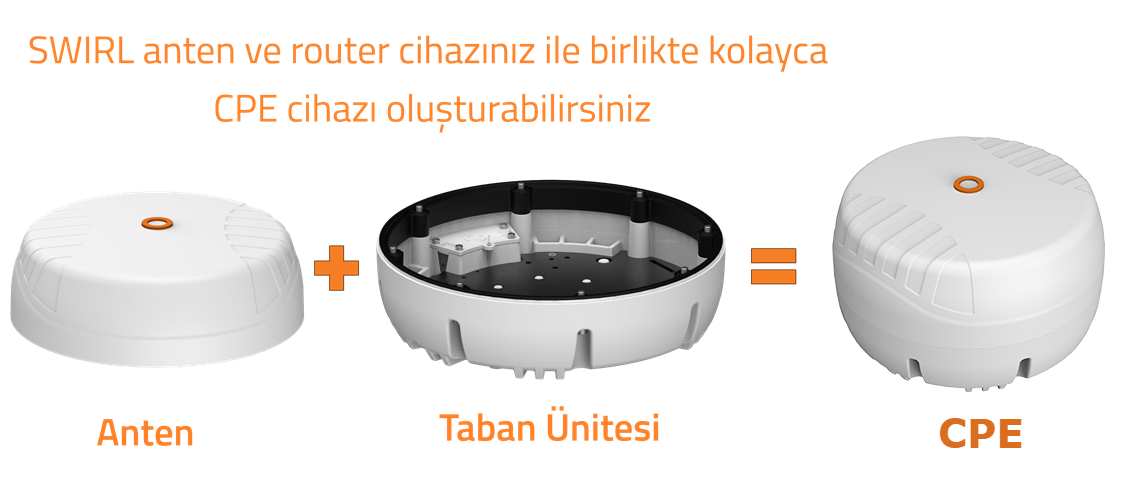
The Poynting SWIRL marine antenna combines 5G/LTE, Wi-Fi 7 and GNSS antennas in a single omnidirectional housing designed for boats and vehicles. It is available as an antenna only or as a CPE that houses the router inside.
- 617–6000 MHz 5G/LTE
- 8×8 or 4×4 MIMO
- Wi-Fi 7
- GNSS L1/L5
- IP69K · IK08

Antenna only or CPE
The Poynting SWIRL marine antenna brings 5G/LTE connectivity, Wi-Fi access and GNSS positioning together in a single outdoor unit for boats, yachts and vehicles. Its omnidirectional design means the antenna never needs re-aligning when the vessel changes heading.
Each pair of cellular elements combines horizontal and vertical polarisation. This helps the router separate MIMO streams and reduces the effect of reflections from the sea surface.
Antenna only
Connects to the router in the cabin with 65 cm cables. For vessels that already have a router.
CPE (with SWIRL-BASE)
A die-cast aluminium base holds the router directly under the antenna. Cable loss is minimised; only Ethernet and power run down to the cabin.

SWIRL-4 and SWIRL-8
| Feature | SWIRL-4 | SWIRL-8 |
|---|---|---|
| Cellular (5G/LTE) | 4×4 MIMO (2 vertical + 2 horizontal) | 8×8 MIMO (4 vertical + 4 horizontal) |
| Wi-Fi | 4×4 MIMO (2 vertical + 2 horizontal) | 4×4 MIMO (2 vertical + 2 horizontal) |
| GNSS | 1 port, L1/L5 | 1 port, L1/L5 |
| Connectors | 9 × SMA (male) | 13 × SMA (male) |
| Antenna only | A-SWIRL-0004-V1-01 EAN 6009710928578 | A-SWIRL-0008-V1-01 EAN 6009710928639 |
| CPE (SWIRL-BASE included) | A-SWIRL-0004-V1-02 EAN 6009710928899 | A-SWIRL-0008-V1-02 EAN 6009710928875 |
| Dimensions | Ø382 × 127 mm (CPE: Ø382 × 224 mm) | Ø382 × 127 mm (CPE: Ø382 × 224 mm) |
| Suitable router | Router with a single 5G (4×4) modem | Router with 2 × 5G (4×4) modems |
The 8 cellular ports of the SWIRL-8 do not mean 8×8 on a single modem; they provide four ports to each of two separate 4×4 5G modems.
Wideband performance
Cellular coverage extends from 617 MHz to 6 GHz. All common 4G bands (700/800/900 MHz, 1800/2100/2600 MHz) and the 3.5 GHz 5G band used in Europe and the Middle East are covered.
| Band (SWIRL-8 cellular) | Vertical gain | Horizontal gain |
|---|---|---|
| 617–960 MHz | 4 dBi | 2 dBi |
| 1427–1517 MHz | 4 dBi | 2 dBi |
| 1710–2700 MHz | 6 dBi | 4 dBi |
| 3400–4200 MHz | 5.5 dBi | 2 dBi |
| 5000–6000 MHz | 4 dBi | 4 dBi |
Wi-Fi gain is 5 dBi at 2.4 GHz and 8.5 dBi at 5–7.2 GHz. GNSS LNA gain is 28 ±3 dB. VSWR ≤2.5:1 for cellular and Wi-Fi, ≤2:1 for GNSS.


Poynting SWIRL specifications
| Cellular frequency | 617–6000 MHz |
|---|---|
| Wi-Fi frequency | 2400–2500 MHz, 5000–7200 MHz (802.11g/n/ac/ax/6E/be) |
| GNSS | GPS L1 1575 MHz, L5 1176 MHz, RHCP, 3.3–5 V |
| Peak gain | Cellular 6 dBi (SWIRL-8), Wi-Fi 8.5 dBi |
| Polarisation | Vertical and horizontal (cellular, Wi-Fi) |
| Radiation pattern | Omnidirectional |
| Impedance / power | 50 Ω, 10 W |
| Cable | 650 mm RG316, SMA (male) |
| Ingress / impact | IP69K, IK08 |
| Salt fog | MIL-STD-810G / ASTM B117 |
| Operating temperature | -40 °C … +80 °C, up to 98% RH |
| Wind survival | ≤186 km/h |
| Radome | UV-resistant E-glass, white |
| Weight (SWIRL-8) | 2.83 kg; CPE version 8.1 kg |
| Compliance | CE, RoHS, E-Mark (E1*10R06/03*10530*00) |

Why SWIRL at sea?
Heading independent
The omnidirectional design needs no alignment, whether the boat swings at anchor or changes course.
Horizontal + vertical polarisation
Two polarisations provide diversity against fading caused by reflections from the sea surface. More: H/V vs X-pol.
Salt and UV resistance
Salt fog tested to MIL-STD-810G / ASTM B117. UV-resistant E-glass radome and die-cast aluminium base.
IP69K and IK08
A housing built to withstand high-pressure wash-down, dust and impact.
Thermal management
The heat sink design keeps the router temperature under control in the CPE version.
Wind survival
Withstands winds up to 186 km/h; suitable for mast and radar arch mounting.
The range achievable at sea depends on base station height, antenna height and the radio horizon; see 4G/5G signal range at sea. For choosing the right antenna by vessel type, see the marine antenna selection guide; for complete systems, see boat internet solutions.
Where is it used?
Marine
Guest Wi-Fi, navigation data, remote monitoring and crew communication in coastal waters and marinas.
Mobility and transport
Passenger Wi-Fi, fleet tracking, live broadcasting and field team connectivity. For vehicle applications, see SWIRL Transport.
Mounting on boats and vehicles
- Marine: The pre-drilled base plate fits standard marine brackets. Mount it on a mast or radar arch with the Poynting BRKT-92 bracket.
- Surface mount: An adhesive surface-mount kit is included in the box for permanent roof or deck installations.
- Magnetic mount: The optional MBK-4 magnetic base kit suits temporary or low-movement installations.
- Position: Mount the antenna as high as possible and outside the radar beam; see marine antenna installation.
- Lightning protection: With the antenna-only version, fit a lightning arrestor on every coaxial line. See lightning protection for boats.

Supports a wide range of routers
The SWIRL-BASE offers two router bays: 231 × 193 × 50 mm or 293.5 × 148.5 × 50 mm. With the router sitting directly under the antenna, coaxial cable loss is kept to a minimum. The models below fit in the base; the number shows how many routers fit.
- 1×Celerway Stratus 2× 5G
- 2×AMIT VHG87B-0G018 5G
- 1×Digi TX40 5G
- 1×Sierra Wireless XR60
- 1×Sierra Wireless XR90
- 1×Cradlepoint IBR900
- 2×Teltonika RUTX50
- 2×Teltonika RUTC50
- 1×Peplink MAX BR2 Pro
- 1×Peplink MAX MBX Mini
- 2×Robustel EG5120
- 2×Robustel DR5020

SWIRL datasheet
The datasheet contains port, gain and mechanical data for all models. Certificates and mounting drawings are available on the manufacturer's SWIRL-8 product page.
About the Poynting SWIRL marine antenna
Should I choose the SWIRL-4 or the SWIRL-8?
The SWIRL-4 is sufficient for a router with a single 5G modem. If you use a router with two 5G modems (dual carrier or bonded connections), the SWIRL-8 provides separate 4×4 MIMO to each modem.
Antenna only or CPE: which is better?
In the CPE version the router sits directly under the antenna, so coaxial cable loss is almost eliminated and only Ethernet runs down to the cabin. If the router stays in the cabin, choose the antenna-only version and keep the cable runs short.
Does SWIRL support European 5G bands?
Yes. The 617–6000 MHz range covers the 4G bands used in Europe and the Middle East as well as the 3.5 GHz band used for 5G.
What are the Wi-Fi ports used for?
They can carry the router's Wi-Fi around the vessel or connect to an access point on the pier. Wi-Fi 6E and Wi-Fi 7 frequencies are supported.
How far offshore can a connection be made?
Range depends on base station and antenna height, coastal topography and the operator's coverage planning, so no fixed value can be given. For antenna recommendations by vessel type, see the marine antenna selection guide.