
 SMART BUOYS AND AUTONOMOUS VESSELS
Smart Buoy Antenna:
4G/5G for Smart Buoys and
Autonomous Vessels
A smart buoy antenna has to keep sensor data flowing from an unmanned platform at sea, and unmanned surface vehicles (USV) face the same challenge.
For sensor data, telemetry, video and remote control, a compact, rugged 4G/5G antenna system matched to the mission's data needs is required.
Connectivity in Unmanned Marine Systems
Although a buoy and an autonomous boat perform different missions, the connectivity design answers the same four questions.
No on-site intervention
When something fails, nobody is nearby. The connection must be stable, and the device must be monitored and restarted remotely.
Limited space and power
Power comes from solar panels or batteries, and there is little room for the antenna. A compact, low-profile antenna is preferred.
Data requirements
A few sensor values on a buoy; real-time telemetry and video on an autonomous boat. The router and antenna are chosen to match.
Waves, salt and UV
The antenna is constantly exposed to waves, salt water and sun; on buoys it may occasionally be submerged.
Smart Buoy Antenna Selection
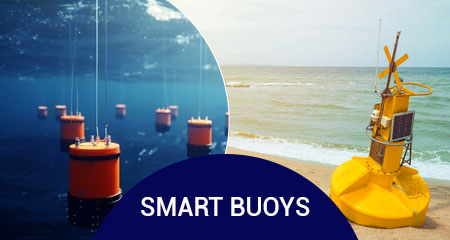
Smart buoys are used for seawater quality, wave and weather measurement, port and channel marking, fish farm monitoring and environmental surveillance. The data sent is usually small, but the connection has to run without interruption for years.
- When a low data rate is enough, an LTE Cat 1 or LTE-M modem lowers power consumption.
- The antenna should be low-profile and impact-resistant; a high IP rating is needed in case it goes under the waves.
- An antenna with a GNSS port is a practical solution for position tracking and drift alarms.
Related: LTE Cat 1 modem advantages · RS-232 LTE Cat 1 modem

PUCK-2
- Frequency617–6000 MHz
- Gain6.5 dBi (LTE)
- Cellular2×2
- MountingLow profile
PUCK-5
- Frequency617–6000 MHz
- Gain6.5 dBi (LTE)
- Cellular2×2
- Extra portsWi-Fi · GNSS

MIMO-4 Series
- Frequency617–7200 MHz
- Gain6 dBi (LTE)
- Cellular2×2 or 4×4
- ModelsMIMO-4-15 · -17 · -19

OMNI-402
- Frequency410–4200 MHz
- Gain5.8 dBi (LTE)
- Cellular2×2
- MountingMast
Autonomous Surface Vessels (USV)
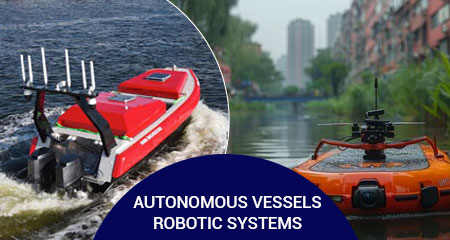
Unmanned surface vehicles are increasingly common in hydrographic surveys, port and infrastructure inspection, environmental monitoring and research. Unlike buoys, they require real-time telemetry, video and remote control; connectivity is part of mission safety.
- Seamless handover is needed between Wi-Fi and remote control within visual range, and 4G/5G beyond visual line of sight (BVLOS).
- Uplink capacity is decisive for video and sensor data; a dual modem provides redundancy with two operators.
- The antenna must fit the vehicle's launch and recovery system and must not be damaged in transport.

SWIRL-8-CPE
- Frequency617–6000 MHz
- Cellular8 ports · 2 × 4×4
- Extra portsWi-Fi · GNSS
- RouterInside the antenna
SWIRL-4-CPE
- Frequency617–6000 MHz
- Cellular4 ports · 4×4
- Extra portsWi-Fi · GNSS
- RouterInside the antenna
PUCK-5
- Frequency617–6000 MHz
- Gain6.5 dBi (LTE)
- Cellular2×2
- Extra portsWi-Fi · GNSS
Which Antenna for Which Application?
Sensor and measurement buoys
Low data, long life. A compact, low-profile antenna with a Cat 1 or LTE-M modem; a GNSS model for position tracking.
PUCK-2 · PUCK-5Mast-mounted marker and monitoring buoys
A marine omni antenna mounted on the mast; a higher mounting point gives wider coverage.
OMNI-402 · MIMO-4 seriesSmall autonomous boats and robots
A compact solution combining 2×2 cellular, Wi-Fi and GNSS in one antenna for limited space.
PUCK-5 · MIMO-4 seriesSurvey and inspection USVs
4×4 or dual modem for video and telemetry; the router sits inside the antenna and only Ethernet / PoE runs into the vehicle.
SWIRL-4-CPE · SWIRL-8-CPESmart Buoy Antenna Comparison
| Model | Frequency | Cellular | Wi-Fi / GNSS | Router | Suitable use |
|---|---|---|---|---|---|
| PUCK-2 | 617–6000 MHz | 2×2 | – | External | Sensor buoy |
| PUCK-5 | 617–6000 MHz | 2×2 | Yes | External | Buoy, small boat |
| MIMO-4 series | 617–7200 MHz | 2×2 / 4×4 | Yes | External | Buoy, small boat |
| OMNI-402 | 410–4200 MHz | 2×2 | – | External | Mast-mounted buoy |
| SWIRL-4-CPE | 617–6000 MHz | 4 ports (4×4) | Yes | Inside the antenna | USV |
| SWIRL-8-CPE | 617–6000 MHz | 8 ports (2 × 4×4) | Yes | Inside the antenna | USV, video |
Other Commercial Marine Applications
For all yacht and commercial vessel applications, see the marine antenna selection guide.




Frequently Asked Questions About Smart Buoy and Autonomous Vessel Antennas
Does a smart buoy need 5G?
Why is the router placed inside the antenna on an autonomous boat?
How do Wi-Fi and cellular work together on a USV?
What happens if the buoy antenna goes under water?
Let's plan connectivity for your buoy or autonomous vessel
Share the mission type, data requirements, power source and operating area, and we will define the modem, antenna and installation setup for you.