

Urban and Rural Antennas 4G/5G for Homes, Offices and Remote Sites
In the city the signal cannot get into the building; in the countryside the base station is too far away. The answer to both is to move the antennas outdoors, to the right spot. Urban and rural antennas cover Poynting's directional and omnidirectional antenna solutions for 4G/5G routers in homes, offices, villas and remote sites.
- 617–6000 MHz
- 2×2 and 4×4 MIMO
- 11 dBi directional
- X-pol cross-polarization
- Outdoor router enclosure
The connectivity problem in urban and rural settings
Urban settings
In the city there is operator coverage, but the signal suffers heavy loss as it enters the building.
- Concrete, steel and energy-efficient (metal-coated) glass weaken the signal.
- Routers in basements, inner rooms and metal cabinets receive a weak signal.
- Many base stations and heavy traffic cause interference (low SINR).
Rural settings
In rural areas the problem is coverage: the base station is kilometres away and the terrain blocks the path.
- Signal level (RSRP) is low and the connection drops often.
- Low frequency bands (700/800/900 MHz) are decisive over long distances.
- Hills, trees and buildings block the line of sight.
Which antenna for which situation?
In the city, base station direction unknown. An omnidirectional X-pol antenna collects signal from every direction: XPOL-1-5G+ or OMNI-0600.
Rural, base station distant and in one direction. High-gain directional antenna: XPOL-2-5G-V3 (2×2) or XPOL-24 (4×4).
Very remote site, wide frequency range. Two LPDA-92 or LPDA-500 antennas for 2×2 MIMO with horizontal + vertical polarization.
The router should be outdoors, right next to the antenna. An ePoynt outdoor enclosure housing the router; only Ethernet runs inside. Example: EPNT-4.
Extend Wi-Fi to the garden, warehouse or a second building. Outdoor Wi-Fi antennas: OMNI-0702 … OMNI-0707.
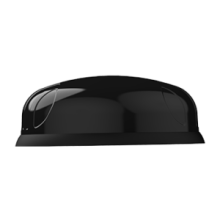
A small, impact-resistant, discreet antenna. PUCK family: with cellular, Wi-Fi and GNSS options.
For the difference between directional and omnidirectional antennas, and a comparison of X-pol with horizontal/vertical polarization, see the FWA polarization guide. Measuring the site's RSRP, RSRQ and SINR values before installation makes the right choice easier. Step-by-step selection: FWA antenna selection.
Poynting urban and rural antennas
Omnidirectional antennas Urban
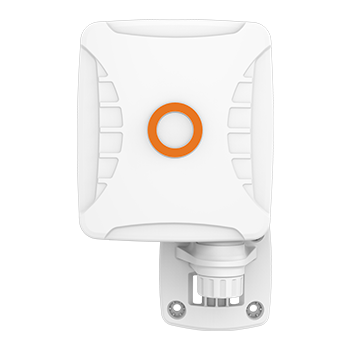
XPOL-1-5G+
Cross-polarized omnidirectional 5G antenna.
- 410–6000 MHz
- 6 dBi (2×2) · 7 dBi (4×4)
- Pole, wall, window · IP65
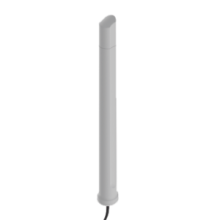
OMNI-0600
Wideband omnidirectional 2×2 MIMO antenna.
- 410–3800 MHz
- 6.2 dBi · 2×2 MIMO
- Pole and wall mount
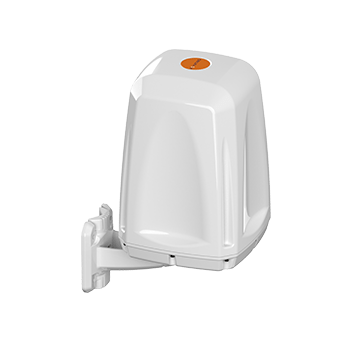
EPNT-4
X-pol 5G / Wi-Fi 6E antenna with router enclosure.
- 617–4200 MHz · 3 dBi
- 4×4 MIMO · Wi-Fi 6E · GNSS
- IP67 · IK10 · 140 × 120 × 50 mm router
Directional antennas Rural
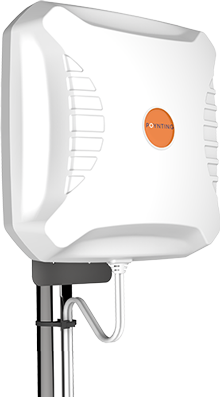
XPOL-2-5G-V3
Cross-polarized directional 2×2 MIMO antenna.
- 617–4200 MHz
- 11 dBi · 2×2 MIMO
- Pole, wall, window
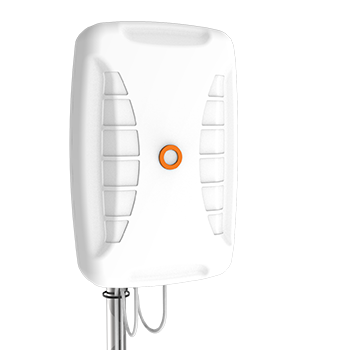
XPOL-24
Directional 4×4 MIMO panel antenna.
- 617–4200 MHz
- 11 dBi · 4×4 MIMO
- IP65 · BRKT-62 mounting
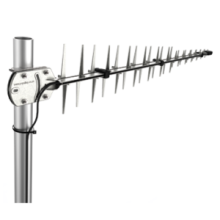
LPDA-92
Log-periodic wideband directional antenna.
- 698–3800 MHz
- 11 dBi · SISO
- 2×2 MIMO with two units
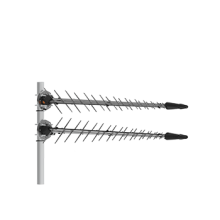
LPDA-500
Directional antenna covering 617–7200 MHz continuously.
- 617–7200 MHz
- 11 dBi · SISO
- Includes 5G and Wi-Fi 6E/7 bands
Outdoor router enclosure (ePoynt CPE)
ePoynt combines the antenna and the 4G/5G router in the same outdoor enclosure. Because the router sits directly behind the antenna, coaxial cable loss is eliminated; only an Ethernet (PoE) cable enters the building. Routers up to 185 × 145 × 45 mm fit inside.
| Model | Frequency | Peak gain | Pattern | MIMO | Datasheet |
|---|---|---|---|---|---|
| EPNT-1 | 617–3800 MHz | 5 dBi | Omni | 2×2 / 4×4 | |
| EPNT-2 | 617–4200 MHz | 11 dBi | Directional | 2×2 |
EPNT-2 at a rural site: AMIT VHG87B + Poynting EPNT-2 field example.
Outdoor Wi-Fi antennas
| Model | Frequency | Peak gain | Use | Datasheet |
|---|---|---|---|---|
| OMNI-0702 | 2.4 GHz | 8 dBi | Long-range 2.4 GHz | |
| OMNI-0703 | 2.4 GHz | 4 dBi | Compact 2.4 GHz | |
| OMNI-0704 | 5 GHz | 4 dBi | Compact 5 GHz | |
| OMNI-0705 | 5 GHz | 7.5 dBi | Long-range 5 GHz | |
| OMNI-0706 | 2.4 – 6 GHz | 5.5 dBi | Dual band | |
| OMNI-0707 | 2.4 and 5 GHz | 5.5 dBi | Dual band |
Compact antennas
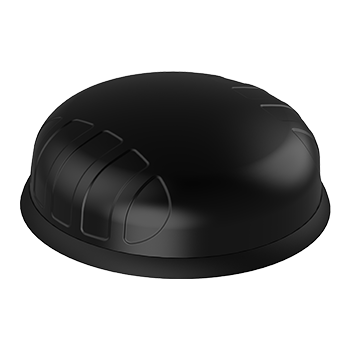
PUCK family
Compact, impact-resistant, IP69K antennas.
- 617–6000 MHz cellular
- Wi-Fi and GNSS options
- 9 models: PUCK-1 … PUCK-14
Correct installation, correct performance
Height
The higher the antenna and the further from obstacles, the better the signal. In rural areas, a few metres of extra mast height can be decisive.
Direction
Point the directional antenna at the base station and fine-tune it by measuring the direction that gives the best SINR. Details: RSRP, RSRQ and SINR measurement.
Cable
Keep the cable short and low-loss; on long runs, move the router closer to the antenna or use ePoynt. Details: LMR cable insertion loss.
MIMO
Connect all of the router's antenna ports. On a 4×4 router, a 4×4 antenna gives a clear speed gain over 2×2.
Lightning protection
On roof and mast installations, grounding and a lightning arrestor on every cable. Details: antenna lightning protection.
Power
With a good signal, the router transmits at lower power and re-establishes the connection less often, which reduces consumption and heat.
About urban and rural antennas
Should I choose a directional or omnidirectional antenna?
If the base station is distant and its direction is known, a directional antenna gives higher gain. In the city, where several base stations are in range and the direction is unclear, an omnidirectional antenna gives more stable results.
How much does an external antenna increase speed?
There is no fixed figure; the result depends on the site's signal level, quality (SINR) and base station load. For a router receiving a weak signal indoors, moving the antenna outside usually brings a clear improvement.
Which antenna does my router support?
Check the router's number of antenna ports (2 or 4) and connector type (SMA, TS-9). Choose a MIMO antenna matching the port count; use an adapter if needed.
Which frequencies matter in rural areas?
Over long distances, low bands such as 700, 800 and 900 MHz are decisive. The chosen antenna must deliver good gain in these bands; Poynting antennas cover from 617 MHz upwards.
Does a window-mounted antenna work?
Yes, especially in the city. However, metal-coated energy-efficient glass can weaken the signal; in that case, moving the antenna outdoors, to the window frame or a wall gives better results.
Read more
For product information, you can also visit the official Poynting website.